Category: Business Banking
Reading Time: 9 minutes
Your Business Changes Every Year—Your Banking Should Too
Most businesses regularly review their budgets, suppliers, software subscriptions, insurance policies, and marketing strategies. These reviews help identify unnecessary costs, improve efficiency, and ensure the business is prepared for future growth.
Yet one area is often overlooked: banking.
Many companies continue using the same banking setup they established years earlier, even though the business itself has changed significantly. New markets, new customers, additional currencies, higher transaction volumes, and changing regulatory requirements can all affect whether an existing banking structure is still fit for purpose.
A banking setup that worked for a small domestic business may no longer support an international company managing cross-border payments every day.
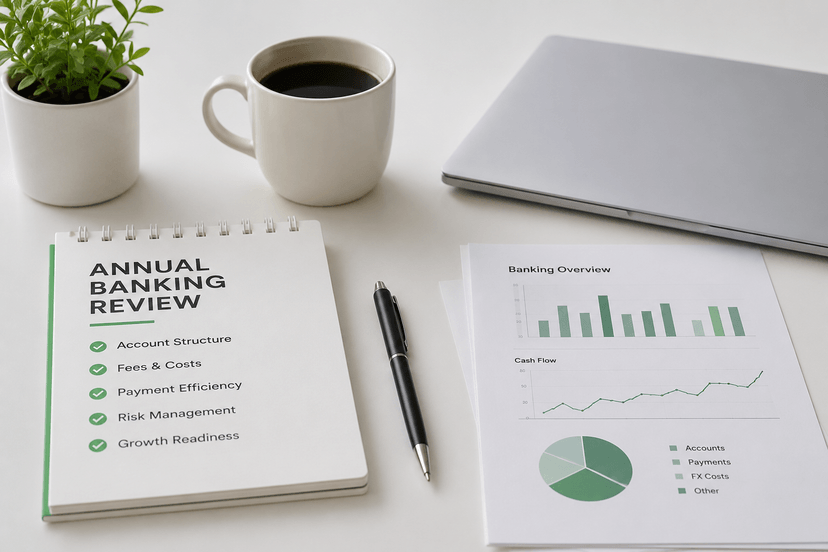
Reviewing your banking arrangements should not only happen when a problem arises. It should become part of your annual business planning.
Just as businesses evolve, the financial infrastructure supporting them should evolve as well.
Growth Changes Financial Requirements
Business growth brings opportunities, but it also introduces operational complexity.
A company that once processed a handful of international payments each month may now be handling hundreds. New suppliers may require payments in different currencies. Customers may expect local account details or faster settlement times. Teams may expand across multiple countries.
Each of these changes places new demands on the banking infrastructure.
The challenge is that banking relationships often remain static while the business continues to grow.
What was once a simple setup can gradually become inefficient. Employees spend more time moving funds between accounts, finance teams work across multiple banking platforms, and reporting becomes increasingly fragmented.
These inefficiencies rarely appear overnight.
Instead, they develop gradually until the business reaches a point where financial operations begin slowing down growth rather than supporting it.
An annual review helps identify these issues before they become expensive operational problems.
Small Inefficiencies Become Expensive Over Time
Not every banking issue is dramatic.
Many businesses continue operating despite unnecessary payment fees, slow settlement times, duplicated processes, or fragmented account structures.
Because these problems develop gradually, they often become accepted as "just the way things work."
Over the course of a year, however, small inefficiencies accumulate.
Additional manual reconciliation takes staff away from higher-value work.
Repeated foreign exchange costs reduce profit margins.
Slow payment processing affects supplier relationships and cash flow planning.
Managing multiple disconnected banking portals increases operational risk and administrative workload.
Individually, these issues may seem manageable.
Together, they can have a meaningful impact on productivity and profitability.
Reviewing banking operations annually provides an opportunity to identify where time, money, and resources are being lost.
International Expansion Often Outgrows Existing Banking Structures
Expanding internationally creates new banking requirements that many businesses underestimate.
Entering a new country may involve local payment expectations, additional currencies, different compliance requirements, and new supplier relationships.
Many companies respond by simply opening another bank account whenever a new requirement appears.
While this solves the immediate challenge, it can eventually create a complex network of disconnected banking relationships.
Finance teams must monitor multiple balances, reconcile transactions across different platforms, and manage separate approval processes.
Without careful planning, international expansion can make financial operations increasingly difficult to manage.
A structured annual review allows businesses to assess whether their banking setup still supports international growth—or whether it has become unnecessarily fragmented.
Banking Technology Continues to Evolve
The financial industry changes quickly.
New payment rails, real-time settlement systems, virtual IBAN capabilities, multi-currency account solutions, and embedded financial services continue to reshape how businesses manage money internationally.
A banking solution selected several years ago may not provide the same capabilities available today.
Businesses that never review their financial infrastructure may miss opportunities to improve efficiency, simplify operations, or better serve international customers.
This does not mean switching providers every year.
Instead, it means understanding what has changed in the market and evaluating whether existing solutions continue to meet business needs.
Annual reviews encourage informed decisions rather than reactive ones.
Risk Management Should Be Part of Every Banking Review
Banking reviews are not only about efficiency.
They are also about resilience.
Businesses should understand how dependent they are on a single banking relationship.
Questions worth considering include:
- What happens if a banking partner changes its risk appetite?
- Could the business continue operating if one account became temporarily unavailable?
- Are payment processes dependent on a single provider?
- Is there sufficient visibility across all accounts and payment flows?
These questions become increasingly important as transaction volumes grow.
Building resilience into financial operations helps reduce disruption if unexpected changes occur.
A review provides an opportunity to identify vulnerabilities before they become operational issues.
Questions Every Business Should Ask During an Annual Banking Review
Rather than reviewing banking purely from a cost perspective, businesses should evaluate whether their financial infrastructure continues to support operational goals.
Useful questions include:
- Does our current banking structure still match how the business operates?
- Are we paying unnecessary fees?
- Are payment processes as efficient as they could be?
- Do we have sufficient visibility across all accounts?
- Are we supporting the currencies our customers and suppliers use?
- Is our banking infrastructure prepared for future expansion?
- Have our risks changed during the past year?
The answers often reveal opportunities for improvement that extend beyond simple cost savings.
How EasyKonto Supports Growing Businesses
EasyKonto helps qualified businesses build financial infrastructure designed for international operations.
Through multi-currency account capabilities, virtual IBANs, international payment solutions, and scalable account structures, businesses can simplify how they manage payments across multiple markets.
Rather than relying on banking arrangements built for an earlier stage of growth, companies can evaluate whether their financial operations continue supporting future expansion.
The goal is not simply adding more banking products.
It is creating a banking structure that remains efficient as the business grows.
Final Thoughts
Businesses rarely question the importance of reviewing marketing strategies, software, suppliers, or financial performance every year.
Banking deserves the same level of attention.
The financial infrastructure supporting a business should evolve alongside the business itself.
Regular banking reviews help identify inefficiencies, strengthen resilience, improve operational visibility, and prepare companies for future growth.
For businesses operating internationally, reviewing banking annually is not simply good housekeeping.
It is part of building an organisation capable of scaling with confidence.