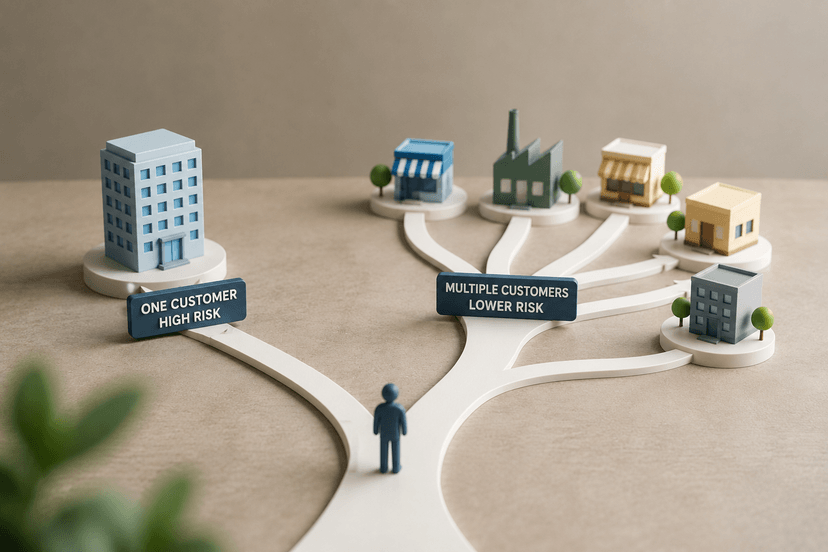
Winning a major customer can transform a business. Becoming too dependent on that customer can quietly create a risk many companies don't recognise until it's too late.
Category: Company Growth
Reading Time: 9 minutes
Introduction
Ask any business owner about the customer that changed their company, and they'll usually remember the story immediately.
For some, it was the first large contract that made hiring possible. For others, it was the customer that finally provided a predictable revenue stream after years of uncertainty. A single commercial relationship can change the direction of a business. It creates confidence, improves cash flow and often gives management the certainty needed to invest in people, technology and future growth.
There is nothing wrong with that. In fact, many successful businesses are built on strong, long-term customer relationships.
The problem begins when one customer gradually becomes more important than anyone realises.
It rarely happens because management makes a conscious decision to depend on one client. More often, the relationship simply grows over time. Orders become larger, projects become more frequent and, before long, one customer represents a significant share of the company's annual revenue.
From a sales perspective, it feels like success.
From a business perspective, it changes the company's risk profile.
When Success Creates A Different Type Of Risk
Most businesses spend years trying to attract larger customers, so it can feel strange to think of success as something that introduces new challenges.
Yet this is exactly what happens when customer concentration becomes too high.
Imagine that one customer accounts for half of your annual turnover. The relationship may be excellent, payments may always arrive on time and both businesses may expect to work together for many years.
Then circumstances change.
A new procurement director joins the company.
The business is acquired by another group.
Budgets are reduced.
Production moves overseas.
Or the customer simply decides to review existing suppliers.
None of these decisions necessarily have anything to do with the quality of your product or service.
But they can still have an immediate impact on your revenue, your hiring plans and your ability to invest in future growth.
This is why experienced business owners don't just measure sales performance. They also pay attention to where their revenue comes from.
Customer Concentration Is A Business Risk, Not A Sales Problem
Many companies don't realise they have a concentration risk because business has been good for several years.
The customer pays on time.
Communication is strong.
The relationship feels secure.
It becomes easy to assume that nothing will change.
But every customer operates in a market they cannot fully control.
Economic conditions change.
Industries evolve.
Management teams are replaced.
Procurement strategies are reviewed.
A customer who has worked with you for ten years can still make a commercial decision that changes your business overnight.
That doesn't make them a bad customer.
It simply reminds us that every business must make decisions based on its own priorities.
Building your company around assumptions you cannot control is rarely a sustainable long-term strategy.
The Strongest Businesses Build Options Before They Need Them
Diversifying your customer base doesn't mean replacing your biggest customer.
It means making sure they are no longer carrying the weight of the entire business.
That often happens gradually rather than through one major decision.
A company expands into a neighbouring industry where its expertise is equally valuable.
Existing customers begin purchasing additional services.
A product originally designed for one market finds demand in another.
Referral business introduces clients with different buying patterns.
Over time, the business develops a healthier balance.
Revenue no longer depends on one contract or one industry.
Instead, it comes from several independent relationships that strengthen the company as a whole.
Growth Should Increase Stability
Many companies measure growth almost exclusively through revenue.
Revenue matters.
But sustainable growth is also about resilience.
A business generating €5 million in annual revenue from fifty customers is generally in a stronger commercial position than a business generating the same revenue from only two.
The difference isn't turnover.
It's flexibility.
When revenue is spread across multiple customers, industries or markets, individual commercial decisions have less influence over the future of the business.
That gives management greater confidence when making long-term decisions about hiring, investment and expansion.
How EasyKonto Supports Growing Businesses
As businesses expand into new industries and international markets, financial operations naturally become more complex.
Receiving payments from customers across different countries, managing multiple currencies and maintaining visibility over international transactions requires financial infrastructure that can grow alongside the business.
EasyKonto helps qualified businesses simplify these operations through multi-currency accounts, virtual IBANs and payment solutions designed for international commerce. With better financial visibility and streamlined payment management, businesses can spend less time managing administration and more time building long-term customer relationships.
Final Thoughts
Every business hopes to win larger customers.
They create opportunities that smaller contracts often cannot.
The challenge is making sure success today doesn't become unnecessary risk tomorrow.
Building a broader customer base isn't about expecting existing customers to leave.
It's about ensuring that your company's future is shaped by its own decisions rather than by the decisions of a single client.
The strongest businesses don't just grow their revenue.
They build a business that's resilient enough to keep growing, regardless of how the market changes.