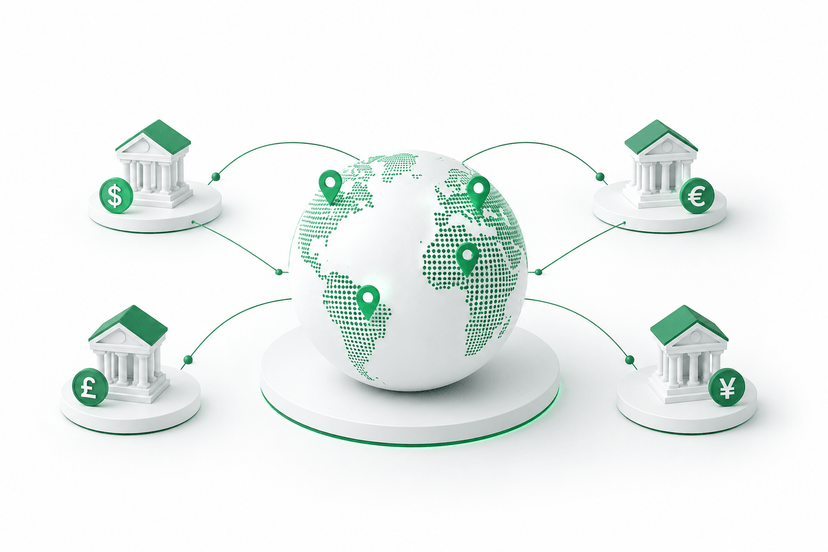
Growing internationally is about more than entering new markets. It also means managing your business finances across different banking systems, currencies, and regions.
Category: Account Management
Reading Time: 8 minutes
Expanding into new countries creates new opportunities, but it also introduces financial challenges that many businesses underestimate.
A company that once operated with a single domestic bank account may suddenly need to receive payments from customers in Europe, pay suppliers in Asia, manage payroll in another country, and monitor balances across multiple currencies.
Without the right structure, financial operations quickly become fragmented.
Different banking platforms, multiple login credentials, inconsistent reporting, and varying payment processes can make even routine financial tasks more time-consuming than they need to be.
Managing business accounts across multiple countries isn't simply about opening more accounts. It's about creating a financial structure that supports international operations while maintaining visibility, efficiency, and control.
Why One Business Account Is Often Not Enough
For businesses operating solely in one country, a single bank account may be sufficient.
International businesses, however, face a very different reality.
Customers often prefer paying in their local currency. Suppliers expect payments through familiar banking networks, and operational expenses may need to be settled in different currencies depending on where the business operates.
Trying to manage every transaction through one domestic account can introduce unnecessary currency conversions, longer settlement times, and additional administrative work.
As international operations expand, businesses often require a financial setup that reflects how they actually operate across different markets.
Managing Multiple Currencies Efficiently
One of the biggest challenges of international business is managing several currencies at the same time.
Receiving payments in euros while paying suppliers in U.S. dollars and covering expenses in British pounds can quickly complicate cash flow management.
Automatically converting every incoming payment into a single currency may seem convenient, but it also removes flexibility and can increase foreign exchange costs over time.
Holding balances in the currencies your business regularly uses provides greater control over international cash flow and allows currency conversions to be planned rather than forced.
For businesses handling frequent cross-border transactions, this flexibility can improve both operational efficiency and financial planning.
Maintaining Visibility Across Markets
As banking relationships grow, so does the challenge of maintaining a clear overview.
Business owners and finance teams need to know:
- Where company funds are held.
- Which accounts are actively being used.
- Available balances across different currencies.
- Incoming and outgoing payments.
- Overall liquidity across all operations.
When this information is spread across several banking portals and financial systems, obtaining a complete picture becomes increasingly difficult.
Good account management should simplify financial oversight, not make it more complicated.
Having clear visibility allows businesses to make faster decisions and respond more effectively to changing market conditions.
Centralising Financial Operations
International growth doesn't necessarily require managing every country through a completely separate financial process.
Many growing businesses benefit from centralising payment operations while still supporting local currencies and regional payment needs.
Centralisation can help standardise payment approvals, improve reporting consistency, reduce manual administration, and simplify financial controls across the organisation.
Instead of managing isolated banking relationships for each market, businesses can create a more connected financial structure that supports both local operations and global oversight.
Avoiding Fragmented Banking Relationships
As businesses expand, it's common to accumulate multiple banking providers over time.
One bank may support domestic payments, another international transfers, and a third specific regional services.
While this often develops naturally, it can also create fragmented financial operations.
Multiple banking portals, separate reporting formats, different payment processes, and inconsistent user permissions can increase complexity rather than reduce it.
Regularly reviewing banking relationships helps ensure that financial infrastructure continues to support the business instead of slowing it down.
The objective isn't necessarily to reduce the number of accounts. It's to ensure those accounts work together as part of a coherent financial strategy.
How EasyKonto Supports International Businesses
EasyKonto helps qualified businesses simplify international financial operations through solutions designed for cross-border commerce.
Businesses can access multi-currency business accounts, virtual IBANs, international payment capabilities, and financial infrastructure that supports operations across multiple countries.
Rather than managing disconnected banking relationships, businesses gain access to solutions designed to improve visibility, simplify payments, and support international growth.
Final Thoughts
International expansion changes more than where a business operates—it changes how financial operations need to be managed.
Building an effective account management strategy means looking beyond individual bank accounts and creating a financial structure that supports multiple markets, currencies, and payment requirements.
Businesses that invest in organised, scalable account management are often better positioned to grow efficiently, maintain financial visibility, and adapt as international operations continue to evolve.