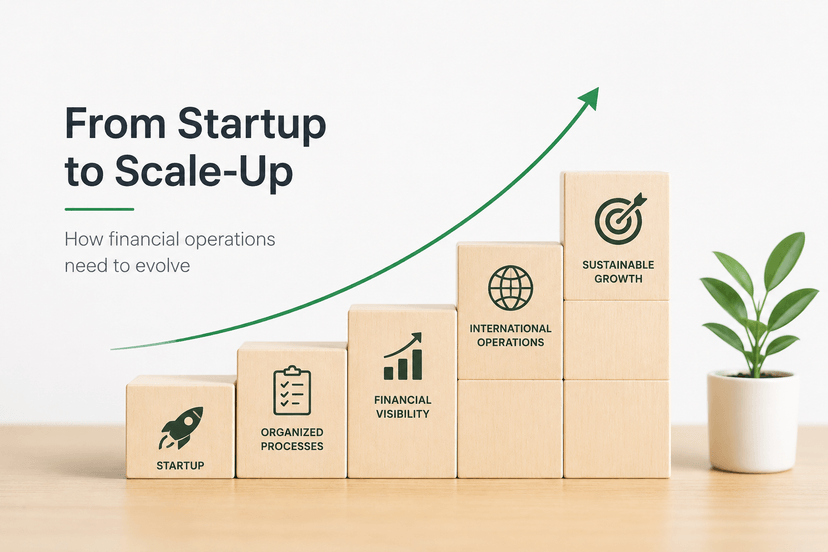
From Startup to Scale-Up: How Financial Operations Need to Evolve
As businesses grow, the systems behind the business need to grow with them.
Category: Company Growth
Reading Time: 8 minutes
When people talk about scaling a business, the conversation usually revolves around hiring, sales, marketing and expansion into new markets.
Financial operations rarely receive the same attention.
In the early stages of a company, that's understandable. A founder can often manage invoices, approve payments and monitor cash flow without much difficulty. Banking is straightforward, transaction volumes are relatively low and financial processes are built around flexibility rather than structure.
As a business grows, however, those same processes begin to show their limitations.
More customers generate more transactions. More suppliers create more outgoing payments. New employees introduce approval workflows, and expansion into international markets adds multiple currencies, additional compliance requirements and more complex financial reporting.
The financial systems that once supported growth can gradually become the very thing that slows it down.
Growth Changes More Than Revenue
Revenue is often the most visible measure of business growth, but it is only one part of the picture.
Every stage of growth increases the complexity of day-to-day operations. Finance teams are expected to process a higher volume of transactions, provide more detailed reporting and support faster business decisions, often without a proportional increase in resources.
This is why many companies discover that scaling is not simply about generating more income. It also requires building operational processes that can handle a larger and more demanding business.
Companies that prepare for this transition early often find it easier to maintain efficiency as they continue to grow.
Financial Processes Should Support Better Decisions
As businesses become larger, financial information plays a more strategic role.
Management no longer relies solely on monthly reports. Decisions about hiring, expansion, purchasing and investment often depend on having accurate financial data available at the right time.
Understanding available cash, outstanding receivables, upcoming supplier payments and financial commitments across different markets becomes essential for effective planning.
When financial information is fragmented across spreadsheets, disconnected banking platforms and manual reports, decision-making becomes slower and less reliable.
A well-organised financial operation gives leadership the confidence to act quickly while maintaining control over the business.
International Operations Introduce New Responsibilities
For many businesses, growth eventually extends beyond their domestic market.
Serving international customers and working with overseas suppliers creates opportunities, but it also introduces new financial responsibilities.
Businesses may need to receive payments in multiple currencies, settle invoices across different jurisdictions and manage exchange rate exposure while maintaining visibility over their overall cash position.
These challenges are rarely solved by adding more manual work.
Instead, they require financial processes and infrastructure that are designed to support international operations from the outset.
The earlier these systems are established, the easier it becomes to expand into additional markets without creating unnecessary complexity.
Preparing Financial Operations for the Next Stage
Successful businesses regularly review the systems that support their growth.
The financial processes that worked well during the startup phase may no longer provide the efficiency or visibility required as the organisation becomes larger.
Reviewing payment workflows, approval procedures, reporting structures and banking relationships should become part of a company's growth strategy rather than a response to operational problems.
Investing in scalable financial processes allows finance teams to spend less time managing administration and more time supporting the strategic direction of the business.
How EasyKonto Supports Growing Businesses
As companies expand internationally, their financial requirements become more sophisticated.
EasyKonto supports qualified businesses with solutions designed for cross-border operations, including multi-currency business accounts, international payment capabilities, virtual IBANs and flexible financial infrastructure.
The objective is to simplify financial operations while giving businesses the flexibility to grow across markets without unnecessary operational friction.
Final Thoughts
The transition from startup to scale-up is not defined solely by higher revenue or a larger customer base.
It is equally defined by the ability to operate efficiently as the business becomes more complex.
Financial operations play a central role in that transition. Well-designed processes improve visibility, reduce unnecessary administration and provide the stability that growing businesses need to make confident decisions.
Companies that invest in scalable financial operations early are often better prepared for the challenges and opportunities that accompany long-term growth.